
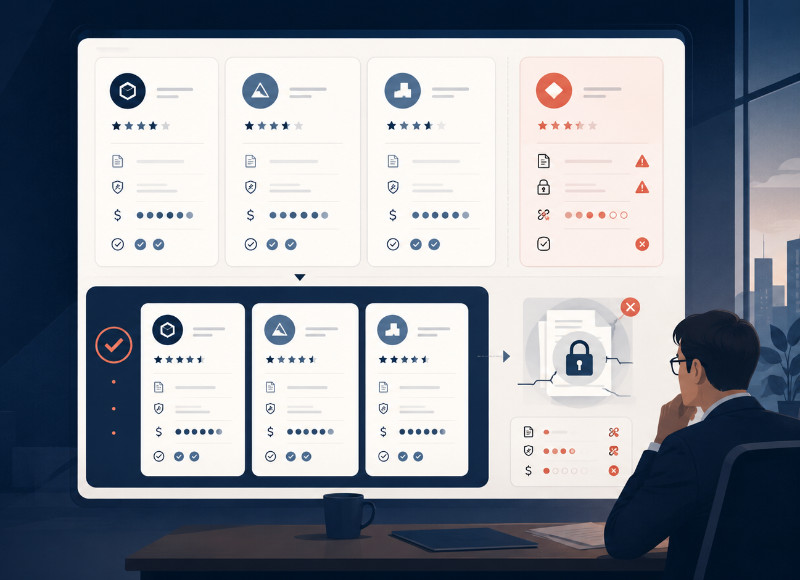
Your next buyer may be an AI agent. Can it understand what you sell?
A procurement manager needs a new supplier. Instead of opening Google and working through a page of search results, she gives an AI agent an assignment:
Find five U.S.-based suppliers that can meet these specifications. Compare their certifications, lead times, service areas, pricing, and relevant experience. Exclude any supplier that cannot document its claims.
The agent searches, reads, sorts, and returns a shortlist.
One qualified supplier never appears. Its certifications are buried in a PDF. Another is skipped because its website says plenty about "innovative solutions" but never explains which applications it supports. A third makes the list, but the agent describes its services incorrectly because the clearest information it found was on an outdated directory profile.
None of those companies receives a website visit, form submission, or sales inquiry. They may never know they were considered.
This isn't how a lot of B2B purchases work today. Humans still make the decisions, and autonomous purchasing agents aren't roaming the internet with corporate credit cards. But AI already has a meaningful role in vendor research. The next step is easy to see: buyers will delegate more of the early work to software.
The question for B2B companies is can a machine understand the website well enough to recommend the company to that person?
The shift has started with familiar tools such as ChatGPT, Gemini, Copilot, Claude, and Perplexity.
A 2026 SEMrush survey of 622 U.S. business professionals found that 66% of respondents who use AI for work regularly use it to research products, vendors, or solutions. Among that group, 92% said AI had shaped a vendor shortlist, and 83% said it had influenced a final vendor decision.
Buyers use these tools to learn the vocabulary of an unfamiliar category, find possible suppliers, compare vendors, and prepare questions for sales calls. AI doesnt need authority to approve a purchase to affect the outcome. It only needs influence over which companies receive a closer look.
Industrial buyers appear ready to delegate even more. In Kula Partners' Q1 2026 Industrial Buyer Pulse research, 52% of respondents said they would be comfortable letting an AI agent build an initial supplier shortlist without live supplier interaction. Another 49% would let an agent summarize technical differences between the options.
A buyer who trusts AI to summarize ten vendors may eventually let it find those vendors too.
A person can infer meaning from design, tone, reputation, and context. An AI system works with the information it can retrieve and interpret.
Consider this sentence:
We help ambitious organizations unlock growth through transformative solutions.
It sounds polished. It also says almost nothing. The same sentence could describe a software company, consultancy, staffing firm, bank, or suspiciously expensive retreat in Arizona.
Now compare it with this:
We provide SEO, paid media, content marketing, lead generation, and marketing automation for B2B SaaS, professional services, and manufacturing companies.
The second version is less grand. It is also useful. A buyer, search engine, or AI system can identify what the company does and who it serves.
An AI agent evaluating vendors may need answers to fairly mundane questions:
If the answers are missing or contradictory, the agent has little reason to improvise on the company's behalf. It can recommend a competitor whose information is easier to verify.
A good number of B2B websites were written to avoid excluding anyone. The result is copy broad enough to include everyone and specific enough to persuade no one.
Terms such as "full-service," "future-ready," and "results-driven" may support a clear description, but they can't replace one. Name the product or service. Describe the problem. Identify the customer.
This is useful for human buyers too. Machine readability isn't a separate form of marketing. Much of it is simply the discipline of saying what you mean.
A company may have excellent proof that is hard to retrieve:
Rich formats still have a place. Buyers may prefer a product configurator, video demonstration, or designed PDF. The underlying facts should also be available as accessible text on a logical web page.
AI systems draw on more than a company's own pages. They may encounter LinkedIn, trade publications, partner directories, review sites, association profiles, press coverage, and old pages preserved elsewhere.
Problems arise when those sources disagree. A rebranded company may still be described under its former name. A directory may list discontinued services. LinkedIn may emphasize a different market than the website. An old pricing page may continue to circulate after the business model changes.
A buyer can sometimes reconcile those differences. A machine may repeat the wrong version or lower its confidence in the answer.
"Trusted leader" is a claim. A case study explaining how a named customer reduced processing time is evidence.
AI-assisted research hasn't eliminated verification. It may be increasing it. Forrester's 2026 business buying research, based on a survey of nearly 18,000 buyers, found that buyers use AI for speed but validate its output through peers, product experts, analysts, and other trusted sources.
Technical buyers are particularly skeptical. The 2026 State of Marketing to Engineers report found that 69% use generative AI during purchasing, yet they rated the trustworthiness of its answers at only 4.7 out of 10. Most respondents who noticed AI search summaries continued into the regular results rather than treating the summary as sufficient.
A company needs to be present in the AI answer and credible when the buyer checks the work.
B2B pricing can be complicated. That doesn't require complete silence.
A company that can't publish an exact price can still explain its pricing model, typical range, minimum engagement, implementation fees, contract structure, or the variables that determine cost. The same applies to lead times, availability, project duration, and prerequisites.
Without that information, an agent can't tell whether the company fits the buyer's constraints. Neither can the buyer.
There is a grim version of this future in which every company replaces its website with a colorless database designed for robots. Nobody wants to read that, including the people who approve B2B purchases.
Good positioning, a distinct point of view, visual communication, and human judgment still matter. Buyers will continue to care whether a company understands their situation and seems credible enough to trust with a consequential purchase.
The practical goal is to make the same website work at two levels. A person should find a clear argument and evidence worth considering. A machine should find explicit facts, consistent terminology, logical page relationships, and information it can verify elsewhere.
Structured data can help search engines and other systems identify products, organizations, authors, reviews, locations, and frequently asked questions. It can't rescue an unclear offer. Adding schema to vague copy merely organizes the vagueness.
You don't need a new platform or a twelve-month transformation project to see where the problems are. Start with the AI tools your customers are likely to use.
Ask each tool:
Use a realistic buyer scenario rather than a broad request for "the best" companies. SEMrush found that use-case fit had more influence on which AI recommendations buyers noticed than brand recognition or appearing first in the response.
Then inspect the answers without being charitable.
Check whether each answer is accurate, specific, and current. Look at which sources the system cites. Note any service it omits, claim it invents, obsolete page it relies on, or competitor it understands better. Repeat the test in more than one AI tool because their answers and source sets differ.
This exercise won't produce a scientific visibility score, but it will show whether the public information about the company is coherent enough to survive automated research.
Start with positioning. The homepage should plainly identify the company, its primary offerings, the customers it serves, and the problems it is equipped to solve. Dedicated service, product, industry, and use-case pages can carry the detail that doesn't belong on the homepage.
Next, inspect the evidence. Attach specific proof to the claims it supports. A case study is more useful when it names the customer's starting problem, constraints, work performed, timeframe, and result. Certifications should be current and easy to find. Experts should have real biographies and visible authorship rather than appearing as anonymous corporate knowledge.
Make the buying constraints visible. Publish pricing guidance where possible. Explain the implementation process and expected timeline. State the systems, regions, applications, or company sizes the offer supports. If a prospect needs certain resources before the work can succeed, say so.
Finally, check the rest of the web. Correct important directories and social profiles. Maintain consistent company descriptions. Seek credible third-party coverage where the company has genuine expertise or data to contribute. Buyers already look beyond vendor websites, and AI systems do the same.
B2B marketers are accustomed to studying website sessions, conversions, and abandoned forms. Agent-assisted research creates a more awkward possibility: a company can be evaluated and rejected without producing any of those signals.
There may be no lost opportunity in the CRM because the opportunity never became visible. The agent couldn't confirm a certification, determine a price range, understand a service, or reconcile conflicting information. It returned another company instead.
Preparing for that requires making the business easier to understand now.
Clear positioning helps people. Accessible specifications help procurement teams. Detailed evidence helps internal champions defend a choice. Consistent information helps search engines and AI systems describe the company accurately.
Your next buyer will probably still be human. The shortlist that buyer sees may not be.

Jake Finkelstein is the Founder and CEO of 10cubed, a Durham, NC-based digital marketing agency helping B2B companies grow through strategy, AI, and automation. A veteran B2B marketer and demand generation specialist, he has spent more than 20 years helping growth-stage and enterprise brands build pipeline, drive revenue, and operationalize modern marketing programs.


